
When you start comparing epoxy vs polyaspartic garage floor coatings, you’re really comparing two coatings that do different jobs in the same system. The honest answer for most Prescott garages is that a layered install using both lasts longer than either coating used alone.
This guide walks through what each coating is, where they shine, where they fall short, and which option fits the climate up here at 5,400 feet.
The Quick Answer
Polyaspartic cures fast and shrugs off UV rays. Epoxy is thicker, cheaper, and bonds to bare concrete better than almost anything else. Used solo, each has real weaknesses. Used together, with an epoxy base and a polyaspartic topcoat, you get a garage floor that holds up to Prescott’s freeze-thaw winters and high-UV summers for 15 to 20 years.
If you’re chasing a true 1-day install for a commercial space, a full polyaspartic system can make sense. For most homeowners in the Prescott Quad Cities, a layered system gives you the best mix of cost, durability, and looks.
What Polyaspartic Actually Is
Polyaspartic is a fast-curing subtype of polyurea. It’s a two-part chemistry that goes down as a clear or pigmented topcoat, usually 4 to 8 mils thick over an epoxy base.
The big draw is speed. Polyaspartic can cure in 15 to 30 minutes per coat, which means a full garage floor can be ground, primed, flaked, and topcoated in a single day. You can drive on it the next morning. A traditional epoxy install usually needs 3 to 5 days before vehicles roll back in.
It’s also UV stable, so it won’t yellow or chalk in direct sun. It resists scratches, hot tires, brake fluid, and the kind of chemical drips that end up on every garage floor over time. That makes it a strong choice for any garage with windows, skylights, or doors that stay open during the day.
The tradeoff is that polyaspartic is tougher to install correctly. It cures so fast that hot weather or high humidity can shrink the working time to a few minutes. A pro crew can handle that. A DIY kit usually can’t. Polyaspartic also costs more than epoxy per coat, and a full polyaspartic system tends to run higher than a layered epoxy and polyaspartic install.
What Epoxy Actually Is
Epoxy is a two-part thermoset resin. You mix a resin and a hardener, and the chemical reaction turns liquid into a hard plastic that bonds tightly to concrete.
A professional epoxy base coat runs 15 to 25 mils thick, which is five to eight times thicker than what you get in a box-store kit. That thickness is what fills small surface imperfections in the slab and creates a continuous, waterproof bond layer.
Epoxy’s strengths are bond, build, and price. Its weaknesses are UV sensitivity and brittleness. Plain epoxy left in direct sun can amber within a couple of summers. Hit with a dropped jack stand, it can crack instead of flex.
That’s why most pro installs use epoxy as the base coat and a UV-stable topcoat over it. The epoxy does the bonding work. The topcoat handles the surface wear.
Side-by-Side: Epoxy vs Polyaspartic on Their Own
Here’s how the two coatings compare as standalone systems.
| Property | Epoxy (Alone) | Polyaspartic (Alone) |
|---|---|---|
| Thickness per coat | 15 to 25 mils | 4 to 8 mils |
| Cure time to drive on | 3 to 5 days | 24 hours |
| Bond to bare concrete | Excellent with grinding | Good with grinding |
| UV resistance | Poor, can yellow | Excellent, stays clear |
| Abrasion resistance | Good | Excellent |
| Chemical resistance | Good | Excellent |
| Flexibility | Brittle | Flexible |
| Slip resistance | Moderate with flake | Can be slick without additives |
| Cost per sq ft installed | $5 to $9 | $8 to $14 |
| Typical lifespan solo | 7 to 12 years | 10 to 15 years |
| Install difficulty | Forgiving | Sensitive to weather |
The takeaway: polyaspartic alone outperforms epoxy alone on UV, abrasion, and cure speed. Epoxy alone costs less and is easier to install correctly. A system that pairs the two outlasts either coating used solo, which is the route we recommend at Prescott Epoxy Company.
How Prescott’s Climate Affects Your Choice
Prescott sits at about 5,400 feet. We get real winters, hot summers, and one of the higher UV indexes in the lower 48. All three factors push the decision toward UV-stable topcoats.
Freeze-thaw cycles are tough on rigid coatings. Concrete expands and shrinks with temperature, and a brittle topcoat that can’t move with it will crack at control joints and edges. A polyaspartic topcoat flexes with the slab, which matters more here than it would in a mild climate.
UV exposure is the other big factor. Plenty of garages in the area have skylights, side windows, or open-door days that put direct sun on the floor. Plain epoxy will yellow within two or three summers under those conditions. A polyaspartic topcoat stops that from happening.
Monsoon humidity in July and August affects polyaspartic installs more than epoxy installs. The faster cure makes the coating more sensitive to moisture in the air. A pro crew schedules around it. For more on how weather plays into project timing, our residential epoxy guide has a useful section.
The System Most Pro Installers Use
A professional garage floor coating system is usually four layers, installed over one or two days.
First, the slab gets diamond ground. Not acid etched. Grinding opens the surface profile so the primer can bite into the concrete instead of sitting on top of it. This is the single biggest factor in whether your floor lasts 2 years or 20. Our team breaks down why prep matters in this guide to epoxy garage floor coatings.
Second, an epoxy primer or base coat goes down. This is where the bond lives. The epoxy penetrates the ground profile and locks in.
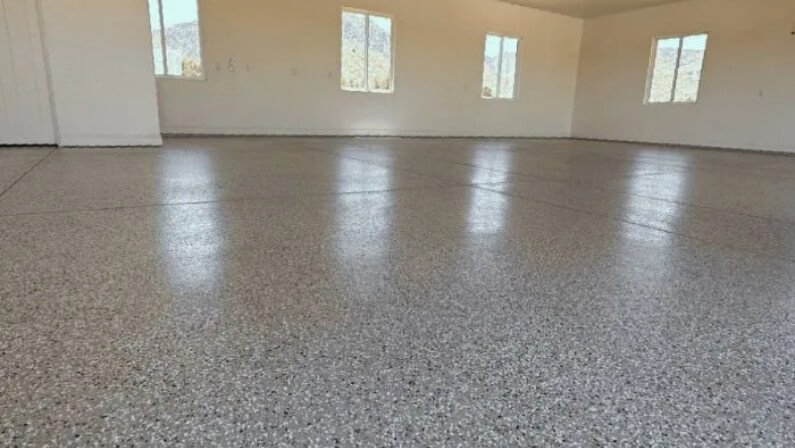
Third, decorative flake or pigment is broadcast into the wet epoxy. This is what gives the floor its color, texture, and slip resistance. Full-flake systems cover the entire slab.
Fourth, a polyaspartic or polyurethane topcoat seals everything in. This is the layer that takes the abuse from tires, tools, and the sun.
The epoxy handles the bond. The polyaspartic handles surface wear. Each layer does what it’s best at, and the full system holds up far longer than either coating alone.
Pure Polyaspartic vs Layered Epoxy and Polyaspartic
Some installers sell a full polyaspartic system, where every coat is polyaspartic instead of layering it over an epoxy base. Here’s how that compares to a layered install.
| Factor | Pure Polyaspartic System | Layered Epoxy + Polyaspartic |
|---|---|---|
| Install time | 1 day | 2 days |
| Drive-on time | Next morning | 3 to 5 days |
| Total coating thickness | 20 to 30 mils | 25 to 40 mils |
| Bond layer | Polyaspartic primer | Epoxy base coat |
| UV resistance | Excellent | Excellent |
| Slip resistance | Depends on flake/grit | Excellent with full flake |
| Cost for a 2-car garage | $3,500 to $5,500 | $2,500 to $4,000 |
| Best for | Commercial 1-day jobs | Residential garages |
| Typical lifespan | 15 to 20 years | 15 to 20 years |
For commercial properties that can’t afford the downtime, a full polyaspartic system is a strong call. For most Prescott homeowners, a layered epoxy and polyaspartic install gives you the same lifespan at a lower price. For the full cost picture on a residential job, check our breakdown of epoxy flooring cost in Prescott.
Which Setup Fits Your Garage?
Pick a layered epoxy and polyaspartic system if your garage has any UV exposure, you want the most cost-effective install, and you’re okay with 3 to 5 days before you park in it. This is the right call for almost every residential garage we coat in Prescott, Prescott Valley, and Chino Valley.
Pick a full polyaspartic system if you absolutely need next-day drive-on, the job is commercial, or downtime costs you real money. The price is higher, but the speed is unmatched.
Pick epoxy alone only if your garage has zero UV exposure, you’re on a tight budget, and you accept the floor may need a refresh sooner. Plain epoxy works in a fully enclosed warehouse or basement where sun never touches the slab. For most Prescott homes, the topcoat is worth it.
We install both systems and walk you through the right choice during your free estimate. You can see flake samples, color options, and finished examples in person at our showroom. Service-area details are on our pages for Prescott epoxy coatings, Prescott Valley epoxy, and Chino Valley epoxy.
Making the Right Call on Epoxy vs Polyaspartic Garage Floor Coatings
The epoxy vs polyaspartic garage floor coatings question doesn’t have a single winner. The right answer depends on your garage, your budget, your timeline, and how much sun touches the slab. For most Prescott homeowners, a layered system with an epoxy base and a polyaspartic topcoat hits the sweet spot of cost, durability, and looks. For commercial spaces that need a true 1-day turnaround, a full polyaspartic install can be worth the premium.
If you want to see samples in person, compare flakes under real light, and get a straight quote for your garage, stop by our showroom at 1030 Sandretto Dr, Suite K in Prescott or call (928) 800-8154 for a free estimate. No pressure, no upsells, just a coating system built to last 15 to 20 years up here.