
If you’re comparing epoxy vs polyurethane garage floor coatings, the honest answer is that neither one is “best” on its own. The longest-lasting floors use both, layered together, with the right prep underneath.
This guide breaks down what each coating actually does, where they differ, and why the pros in Prescott use them together instead of picking sides.
The 30-Second Answer
Epoxy is the base. It’s thick, hard, and sticks to concrete like nothing else when the slab is ground properly. Polyurethane (sometimes called polyurea in newer systems) is the topcoat. It’s flexible, UV stable, and shrugs off scratches and chemicals.
Used alone, each has real weaknesses. Epoxy by itself can yellow in sunlight and crack under impact. Polyurethane by itself doesn’t bond well to bare concrete and wears through faster than most people expect. Together, they make a garage floor that holds up to Prescott’s freeze-thaw cycles, monsoon humidity, and everyday abuse for 15 to 20 years.
What Epoxy Actually Is
Epoxy is a two-part thermoset resin. You mix a resin with a hardener, and a chemical reaction turns the liquid into a solid plastic. Once it cures, it’s tough, thick, and fused to the concrete underneath.
A professional epoxy base coat runs 15 to 25 mils thick, which is about five to eight times thicker than a box-store kit. That thickness is what gives it the ability to fill small imperfections in the slab and create a continuous, waterproof layer.
Epoxy’s strengths are bond strength and build. Its weaknesses are UV sensitivity and brittleness. Left exposed to direct sun, plain epoxy can amber or chalk over time. Hit with a dropped jack or sharp tool, it can crack instead of flex.
That’s where the topcoat comes in.
What Polyurethane Actually Is
Polyurethane is a different chemistry. It’s also a two-part system, but it cures into a flexible, rubbery coating that resists UV rays, chemicals, and abrasion far better than epoxy.
On a garage floor, it goes down as a thin topcoat, usually 3 to 5 mils over the epoxy base. It doesn’t need to be thick because it’s not doing the bonding work. It’s doing the protection work.
Polyurethane’s strengths are UV stability, flexibility, chemical resistance, and scratch resistance. Its weakness is that it bonds poorly to raw concrete. Apply it directly to a slab with no primer or base coat and it’ll lift, peel, or blister within a year or two.
This is the part most homeowners miss when they see “polyurethane garage floor kits” online. The kit works for a while, but without an epoxy or polyaspartic primer underneath, the bond isn’t there.
Side-by-Side: Epoxy vs Polyurethane on Their Own
Here’s how the two coatings compare when each is used as a standalone system.
| Property | Epoxy (Alone) | Polyurethane (Alone) |
|---|---|---|
| Thickness | 15 to 40 mils | 3 to 5 mils |
| Bond to bare concrete | Excellent with grinding | Poor without a primer |
| UV resistance | Can yellow or chalk | Excellent, stays clear |
| Abrasion resistance | Good | Excellent |
| Chemical resistance | Good (oil, gas) | Excellent (brake fluid, solvents) |
| Flexibility | Brittle, can crack on impact | Flexible, absorbs impact |
| Cure time to drive on | 3 to 5 days | 24 to 48 hours |
| Cost per sq ft installed | $5 to $9 | $8 to $14 |
| Typical lifespan solo | 7 to 12 years | 3 to 6 years |
The takeaway: epoxy alone lasts longer than polyurethane alone on a garage floor. But a full system that layers both lasts longer than either one on its own. That’s the coating we install at Prescott Epoxy Company, and it’s why we offer a 10-year warranty.
Why Layering Them Works Better
A professional garage floor coating system is usually four layers, installed over two days.
First, the slab gets diamond ground. Not acid etched. Grinding opens the surface profile so the primer can bite into the concrete instead of sitting on top of it. This is the single biggest factor in whether your floor lasts 2 years or 20. Our team covers why prep matters in this guide to epoxy garage floor coatings.
Second, an epoxy primer or base coat goes down. This is where the bond lives. The epoxy penetrates into the ground profile and locks in.
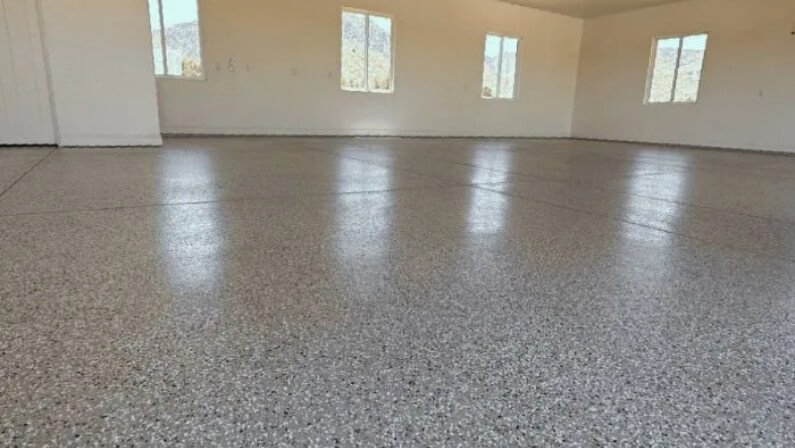
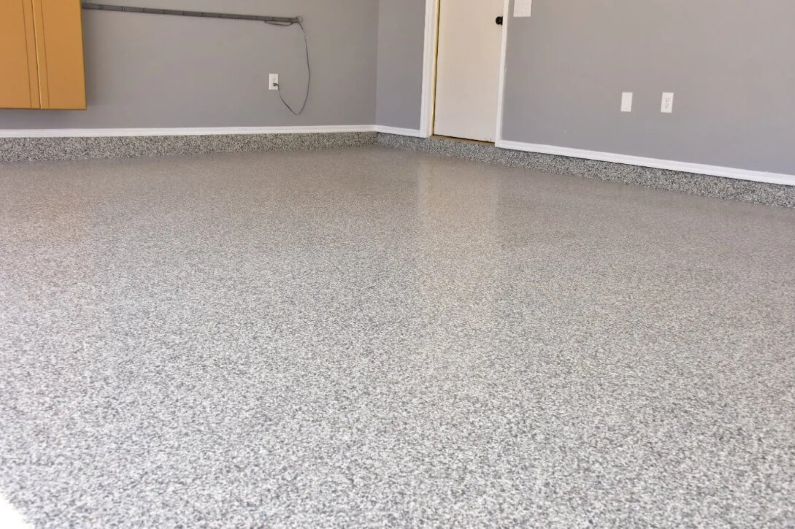
Third, decorative flake or pigment is broadcast into the wet epoxy. This is the layer that gives the floor its color and texture. Full-flake systems cover the entire floor in vinyl chips. Solid color systems skip the flake.
Fourth, a polyurethane or polyaspartic topcoat seals everything in. This is the layer that takes the abuse. It resists UV, tire marks, dropped tools, and the antifreeze and brake fluid that end up on every garage floor eventually.
The epoxy handles bonding. The polyurethane handles surface wear. Each layer does what it’s best at, and the system as a whole outlasts either coating used solo.
How Prescott’s Climate Changes the Comparison
Prescott sits at about 5,400 feet. That elevation brings bigger temperature swings than most of Arizona, real freeze-thaw cycles in winter, and strong UV exposure year-round.
Temperature swings are hard on brittle coatings. Concrete expands and contracts with the weather, and a rigid coating that can’t flex along with it will crack at the edges and control joints. A polyurethane topcoat gives the system a little bit of give, which matters more in Prescott than it would in a mild coastal climate.
UV exposure is the other big factor. A lot of Prescott garages have windows, skylights, or doors that stay open during the day. Direct sun on plain epoxy will turn it yellow or chalky in two or three summers. A UV-stable polyurethane topcoat keeps the color looking sharp for a decade or more.
Monsoon humidity in July and August affects cure times more than finished performance. A pro crew schedules around it. If you’re curious how weather plays into project timing, our residential epoxy guide has a section on it.
DIY Kits: What They’re Actually Selling You
Box store “garage floor kits” are usually one of three things: a water-based epoxy, a thin one-part polyurethane, or a 1-part acrylic labeled as “epoxy paint.” None of them are a true two-layer system.
Here’s the honest breakdown of what you’re getting versus a professional install.
| Factor | DIY Kit | Professional System (Epoxy + Polyurethane) |
|---|---|---|
| Total coating thickness | 4 to 10 mils | 25 to 45 mils |
| Prep method | Acid etch pouch | Diamond grinding |
| Number of layers | 1 or 2 | 3 to 4 |
| UV topcoat included | Usually no | Yes |
| Flake coverage | Partial sprinkle | Full broadcast, back-rolled |
| Warranty | 1-year product only | 10-year installation |
| Expected lifespan in Prescott | 1 to 3 years | 15 to 20 years |
| Typical all-in cost for a 2-car garage | $300 to $600 | $2,000 to $3,600 |
The math only looks favorable on a kit if you ignore the redo. Once a DIY coating fails, grinding it off and starting over usually costs more than just doing it right the first time. Most of the calls we get in Prescott Valley and Chino Valley are from folks whose garage kit peeled within two winters.
For the full cost picture on a pro install, check our breakdown of epoxy flooring cost in Prescott.
Polyaspartic: The Newer Cousin in the Conversation
You’ll also see polyaspartic coatings advertised as a “1-day garage floor.” Polyaspartic is a fast-curing subtype of polyurea, and it’s a legitimate option for a topcoat or even a full system in some cases.
It cures fast, it’s UV stable, and it can be driven on the next day. The tradeoffs are that it’s harder to work with in hot weather, it can be slicker than a textured flake system, and a full polyaspartic system typically costs more than an epoxy-plus-polyurethane system.
For most Prescott homeowners, a layered epoxy base with a polyurethane or polyaspartic topcoat is the best balance of cost, durability, and appearance. For commercial spaces that need a true overnight turnaround, a full polyaspartic system can make sense.
Which One Is Right for You?
Pick epoxy alone if you have a fully enclosed, no-window garage with no UV exposure and you’re okay with a floor that lasts 7 to 10 years. Pick polyurethane alone if you already have a properly primed, coated slab and just need to refresh the topcoat.
For a new install on a raw concrete garage floor in the Prescott area, a layered system is the right call almost every time. An epoxy base gives you the bond and build. A polyurethane or polyaspartic topcoat gives you the UV and abrasion resistance. Together, they outlast either coating alone by a wide margin.
If you’re weighing options and want to see samples in person, our showroom at 1030 Sandretto Dr, Suite K in Prescott is the only epoxy showroom in the area. We also serve Prescott Valley and Chino Valley with the same layered system. Details on service pages for Prescott epoxy coatings, Prescott Valley epoxy, and Chino Valley epoxy.
Picking the Right Epoxy vs Polyurethane Garage Floor Coatings Combo
The epoxy vs polyurethane garage floor coatings debate doesn’t really have a winner. The winning answer is both, layered, over a properly ground slab, installed by a licensed local crew that stands behind the work. That’s the floor that handles Prescott’s summers, winters, and everything homeowners drag across it for two decades.
If you want to see samples in person, compare flake colors under real light, and get a straight quote on what your garage would cost, stop by the showroom in Prescott or call (928) 800-8154 for a free estimate. No pressure, no upsells, just a layered coating system built to last. For the full overview of every coating we install, start with our ultimate guide to epoxy floor services.