
Commercial epoxy floor installations give businesses a flooring solution that handles heavy foot traffic, chemical spills, and daily wear without constantly needing repairs or replacement. If you are weighing your options for a retail space, warehouse, restaurant, or office, this guide walks you through exactly what to expect from the process, the costs, and the results.
Why Businesses Choose Epoxy Over Other Flooring Options
Commercial spaces put flooring through a lot. Forklifts, foot traffic, dropped equipment, cleaning chemicals, and moisture all take a toll over time. Most standard flooring options are not built to handle that combination without chipping, staining, or wearing through.
Epoxy bonds directly to concrete and creates a surface that is far harder than paint or sealers. It resists impacts, repels liquids, and holds up under the kind of pressure that would destroy softer flooring materials in a fraction of the time. And because it is seamless, there are no grout lines or seams where bacteria and grime can collect, which matters a lot in food service and medical environments.
Where Commercial Epoxy Floor Installations Make the Most Sense
Epoxy is a strong fit for a wide range of commercial environments. The coating performs best in spaces where durability and cleanliness are both a priority.
Warehouses and Manufacturing Facilities
These are high-demand environments where floors take constant punishment from heavy equipment and pallets. Epoxy holds up well and can be color-coded to mark safety zones, walkways, and storage areas, which adds a functional layer on top of the visual upgrade.
Retail Stores and Showrooms
Retail spaces benefit from the polished look epoxy provides. A clean, reflective floor makes a space feel larger and more professional. For a textured finish that still looks sharp, best epoxy pebble flooring is a popular choice in showrooms where aesthetics matter as much as durability.
Restaurants and Commercial Kitchens
Kitchens need floors that handle grease, moisture, and frequent cleaning without deteriorating. Epoxy is chemical-resistant and seamless, which makes it practical for food prep areas. Adding an anti-slip aggregate to the topcoat keeps it safe for staff in wet conditions.
Auto Shops and Service Bays
Garages and service bays deal with oil, hydraulic fluid, and heavy vehicles every day. A properly installed epoxy system handles all of that and stays looking clean longer than bare concrete. The same principles that apply in commercial bays also carry over to residential garages, which you can read more about in our guide to epoxy garage floor coatings.
What the Epoxy Floor Installation Process Looks Like
Commercial epoxy floor installations follow a structured process. Each step builds on the one before it, and cutting corners at any stage reduces how long the floor will last.
Moisture Testing and Site Assessment
Before any work begins, a contractor will test the concrete for moisture content. High moisture levels can prevent the epoxy from bonding properly, which leads to bubbling and delamination later. This step is not optional on a quality job. The site assessment also checks for cracks, contamination, and surface condition so the right prep approach gets chosen.
Concrete Surface Preparation
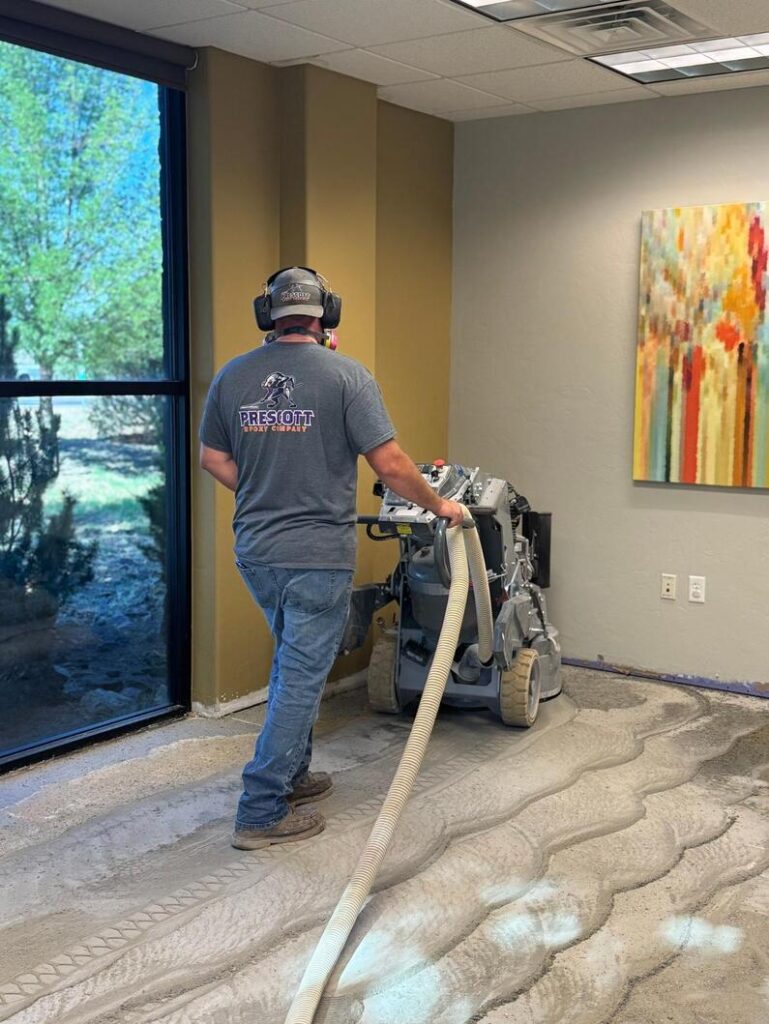
This is the most important part of the whole process. Diamond grinding or shot blasting opens up the pores of the concrete so the epoxy can get a mechanical grip. Any cracks get repaired, joints get addressed, and the floor gets cleaned thoroughly before coating begins. Surface prep takes time and equipment, but it is what separates a floor that lasts a decade from one that starts peeling in a year.
Primer Application
The primer penetrates the prepared concrete and creates a stable base for the coating system. It also helps block any residual moisture from working its way up through the slab.
Base Coat and Broadcast
The base coat goes down next. For commercial spaces, contractors often broadcast decorative flake or quartz aggregate into the wet coat. This adds texture for slip resistance and gives the floor a finished look. Color options are wide, so the floor can match brand colors or blend with interior design.
Topcoat
A clear polyurethane or polyaspartic topcoat seals the system and adds the final layer of protection. This is where UV stability and chemical resistance get locked in. For a full picture of coating options available in the area, take a look at epoxy coatings services in Prescott.
Commercial Epoxy Floor Installations vs. Other Commercial Flooring
Here is how commercial epoxy floor installations compare to other flooring types commonly used in business settings:
| Flooring Type | Durability | Maintenance | Slip Resistance | Avg. Cost (sq ft) | Best Setting |
|---|---|---|---|---|---|
| Commercial Epoxy | Very High | Low | Customizable | $4 to $14 | Warehouses, retail, kitchens |
| Polyaspartic Coating | Very High | Low | Customizable | $6 to $16 | Fast-turnaround commercial jobs |
| Polished Concrete | High | Low | Moderate | $3 to $10 | Showrooms, offices |
| Vinyl Composition Tile | Medium | Medium | Moderate | $2 to $6 | Offices, light retail |
| Ceramic Tile | Medium | High | Varies | $5 to $15 | Restrooms, lobbies |
| Bare Concrete (sealed) | Low-Medium | High | Low | $1 to $3 | Budget-limited spaces |
If a polished look without a coating system is more in line with your vision, it is worth exploring the best concrete polishing services in Prescott AZ as an alternative path.
What Do Commercial Epoxy Floor Installations Cost?
Costs vary based on the size of the space, the condition of the existing concrete, and the system being installed. Here is a realistic range for common commercial project types:
| Space Type | Typical Square Footage | Estimated Cost Range |
|---|---|---|
| Small retail or office | 500 to 1,000 sq ft | $2,000 to $10,000 |
| Restaurant or commercial kitchen | 1,000 to 2,500 sq ft | $4,000 to $25,000 |
| Auto shop or service bay | 1,500 to 3,000 sq ft | $6,000 to $30,000 |
| Mid-size warehouse | 5,000 to 15,000 sq ft | $20,000 to $105,000 |
| Large industrial facility | 15,000+ sq ft | $60,000 and up |
Costs vary based on the size of the space, the condition of the existing concrete, and the system being installed. Here is a realistic range for common commercial project types:

How to Prepare Your Business for Installation
A little planning on your end makes the installation go smoother and reduces downtime. Clear the space of equipment, furniture, and anything stored on the floor before the crew arrives. If the job is happening in a space that needs to stay operational, talk to your contractor about phased installation, where sections get done in stages so part of the floor stays usable.
It also helps to understand what you are getting into with product types before committing. If you have never worked with epoxy coatings before, epoxy paint: what you need to know before your next project is a good starting point to get your bearings on terminology and product differences.
Frequently Asked Questions About Commercial Epoxy Floor Installations
Most commercial epoxy floor installations take one to three days depending on the size of the space and the system being applied. Light foot traffic is usually safe within 24 hours of the final coat. You will want to wait at least 72 hours before bringing in heavy equipment or vehicles. Full cure, when the floor reaches maximum hardness and chemical resistance, takes about seven days. If your timeline is tight, a polyaspartic system can cut that down significantly since it cures much faster than standard epoxy.
Yes, new concrete still needs to be properly prepared before epoxy goes down. Fresh concrete has a smooth surface layer called laitance that forms during curing and prevents coatings from bonding properly. Grinding removes that layer and opens up the pores so the epoxy can grip. New concrete also needs to be fully cured, which takes at least 28 days, before any coating work begins. Applying epoxy to concrete that has not fully cured is one of the more common reasons for premature coating failure.
A professionally installed commercial epoxy system typically lasts 10 to 20 years depending on traffic levels, maintenance habits, and the quality of the system used. High-traffic areas like loading docks and drive-through lanes will see more wear than a back office or storage room. Regular cleaning and an occasional topcoat refresh can extend the life of the floor significantly. Floors in lower-traffic commercial spaces can easily hit the higher end of that range with basic care.
In some cases, yes. Epoxy can go over existing concrete coatings if the old coating is fully bonded, in good condition, and compatible with the new system. However, most professional contractors prefer to remove old coatings entirely before applying a new system. Layering over a failing or incompatible coating almost always leads to adhesion problems down the line. If there is existing tile, it typically needs to come up unless it is perfectly flat, firmly bonded, and can be ground down to create a suitable profile for the epoxy to grab onto.
A standard high-gloss epoxy topcoat can be slippery when wet, which is a real concern in commercial settings like kitchens, restrooms, and entryways. The solution is straightforward: an anti-slip aggregate like aluminum oxide or quartz sand gets broadcast into the topcoat before it cures, creating a textured surface that provides grip in wet conditions. The texture level can be adjusted based on how much slip resistance you need, so a showroom floor and a commercial kitchen floor can have the same base system but different safety profiles.
Moisture is one of the biggest threats to a long-lasting epoxy floor. When water vapor moves up through the concrete slab and gets trapped under the coating, it creates pressure that causes the epoxy to bubble and peel away from the surface. Testing identifies whether moisture levels are within the acceptable range for the coating system being used. If moisture is too high, a moisture-mitigation primer gets applied first to create a barrier before the main coating system goes down. Skipping this step on a slab with moisture issues almost guarantees the floor will fail prematurely.
Get It Done Right the First Time With Prescott Epoxy
Commercial epoxy floor installations are one of the smartest long-term investments a business owner can make in their facility. The right system protects your concrete, keeps the space looking professional, and holds up for years without demanding constant attention or repair costs.
If your business is in the Prescott area, Prescott Epoxy brings the experience, equipment, and products to handle commercial jobs of any size from start to finish. The team takes surface prep seriously, uses quality materials, and delivers a finished floor that actually lasts. Get in touch to schedule a walkthrough and get a quote tailored to your space.